
 |
 |
 |
|
 |
This chapter provides an overview of the main issues on Greek phonology, script and pronunciation. Although care has been taken not to omit any important fact, you may refer to the respective (preceding) pages for more details.
Greek has 32 distinct sounds (or "phones"). In order to represent the various sounds more accurately, I will use my own notation system, let's (…modestly :-) ) call it "Angelos' Latin-based Phonetic Alphabet for Greek" or ALPAG. ALPAG expresssions will be placed between stars, e.g., *kanlís*, with the stressed syllable indicated with a vowel bearing the acute (á, é, í, ó, ú).
The Greek vowel sounds coincide with the five vowels of the Latin alphabet: a, e, i, o, u, which are used for their ALPAG representation. In the following examples, the pronunciation of the letters in bold represents (one way of pronouncing) the corresponding Greek vowel.
| ALPAG | IPA | English Examples | Other-Language Examples | |||
| *a*a | /a/, /ɐ/, /ɑ/ | father, spa, butt | banderas[SPA] | pasta[ITA|Italian] | café[FRA|French] | Angst[GER] |
| *e*e | /e/, /ɛ/ | bed, said | España[SPA] | terra[ITA], che[ITA] | café[FRA], frère[FRA] | spät[GER], Fest[GER] |
| *i*i | /i/ | seat, Greek, decent | viva[SPA] | pizza[ITA] | oui[FRA] | Wiener[GER] |
| *o*o | /o/, /ɔ/ | saw, thought, dog | costa[SPA] | cotto[ITA] | eau[FRA] | Oktoberfest[GER] |
| *u*u | /u/ | fool, would | cubo[SPA] | tiramisù[ITA] | tour[FRA] | kaputt[GER] |
In the provided examples, the pronunciation of the letters in bold represents the corresponding sound. Examples between braces {.} refer to approximate pronunciation or to one of many alternative pronunciations. When the English example may not be sufficient for describing the corresponding sound, examples in other languages are provided. The sound samples are for the combination of the consonant with *a*, i.e., *ba*, *da*, etc.
| ALPAG | IPA | English Examples | Other-Language Examples |
| *b*ba | /b/ | boat, bill | |
| *d*da | /d/ | doll, day | |
| *f*fa | /f/ | football, fish | |
| *g*ga | /g/ | goal, gum | |
| *k*ka | /k/ | account, pink | |
| *l*la | /l/ | left, love | |
| *m*ma | /m/ | mean, emission | |
| *n*na | /n/ | noun, annoy | |
| *p*pa | /p/ | appeal, please | |
| *r*ra | /r/ | {river|particularly Scottish pronunciation} | perro[SPA] |
| *s*sa | /s/ | stay, assign | |
| *t*ta | /t/ | assist, mutant | |
| *v*va | /v/ | vase, reveal | |
| *z*za | /z/ | zoo, cousin | |
| *θ*tha | /θ/ | thesis, thin | |
| *δ*dha | /ð/ | this, brother | |
| *χ*kha | /x/ | {loch|particularly Scottish pronunciation} | Bach[GER], reloj|not to be confused with the /h/ pronunciation of some American-Spanish dialects[SPA] |
| *γ*gha | /ɣ/ | {woman} | {fuego[SPA]} |
| *k*kja | /c/ | keep, Kyoto | équipe[FRA] |
| *g*gja | /ɟ/ | give, get | spaghetti[ITA], Lamborghini[ITA],guerre[FRA] |
| *χ*khja | /ç/ | {Houston, humid|not the /justən/, /juməd/ pronunciation of... George W} | ich[GER] |
| *γ*ghja | /ʝ/ | Yale, yes | {ja[GER]}, {yo[SPA]}, Juventus[ITA] |
| *n*nja | /ɲ/ | {new}, {lasagna} | España[SPA], cognac[FRA], bagno[ITA] |
| *l*lja | /ʎ/ | {million} | tagliatelle[ITA] |
| *nγ*nga | /ŋ/ | finger, sing | |
| *ts*tsa | /ts/ | {tsunami} | Blitzkrieg[GER], pizza[ITA] |
| *dz*dza | /dz/ | pods |
Greek employs its own alphabet and a number of special marks.
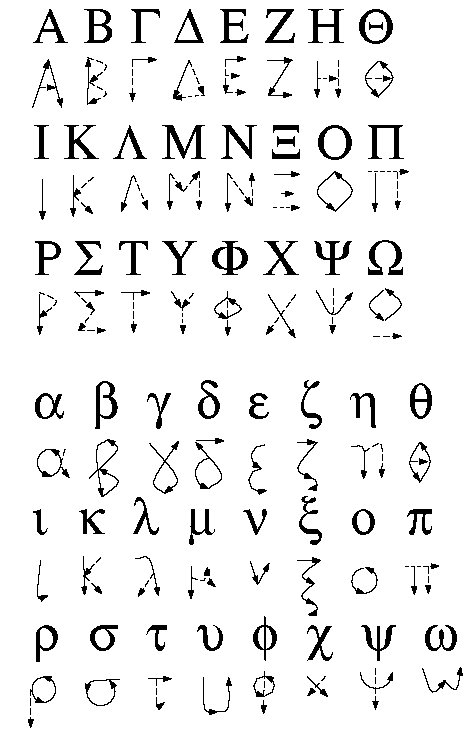
The letters of the Greek alphabet are presented in their upper- and lower-case variants in the following table on the left. On the right, I include a rough guide about "how to write the Greek letters"; the solid curves are to be drawn first and then the dashed and dotted ones.
|
 |
In Greek, a word's stressed syllable (always one of the last three) is denoted by a small vertical or oblique (tilted to the right) line called "οξεία"(=*oksía*) or simply "τόνος"(=*tónos*) and usually rendered in English as acute or accent, respectively over (if lower-case) or to the left of (if capitalised) the syllable's vowel, much like Spanish. The accent is only placed over lower-case vowels (e.g., μάθημα|lesson) or next to the capitalised first vowel of a word (e.g., Άγγελος|Angelos); when the syllable's vowel is rendered as a "diphthong", namely a vowel digraph, the accent is placed over the diphthong's second vowel, e.g., ωραία|beautiful (f.)=*oréa*. When writing in All Caps, the customary practice is (unlike Spanish) not to mark the accent, e.g., ΑΓΓΕΛΟΣ ΚΑΝΛΗΣ|ANGELOS KANLIS. It is also possible that a word receives two accents (of equal stress), its original accent on the antepenult|ante penultimate, last but two, third last syllable and a second one on the ultima|last syllable, e.g., ο άγγελός μου|my angel, but only when it is followed by an (unstressed) enclitic. In general, monosyllabic|consisting of only one syllable words receive no marking for stress (i.e., no accent).
In case a vowel digraph is to be pronounced as two separate vowels, a horizontal double dot (called διαλυτικά=*διαlitiká* in Greek and diaeresis in English) over the second vowel of the diagraph is used; thus, e.g., Καϊμάν|Caiman [crocodile], Cayman [islands](=*kaimán* or, rarely, *kaimán*) or combined with the accent Ναΐτες|Templars(=*naítes*).
The apostrophe (απόστροφος=*apóstrofos*) denotes a vowel sound that has been elided (cf. English "he's", "can't", "rock 'n' roll"), e.g., απ' εδώ=*ap eδó* stands for από εδώ|from here, this way=*apo eδó* after elision of the first word's last vowel.
The punctuation marks of Greek are more or less the same as in English:
The "normal" (primary and {secondary}) values of the letters of the Greek alphabet are:
| Letter | Value | Remarks |
| Α/α | *a* | |
| Β/β | *v* | |
| Γ/γ | *γ* {*γ*, *n*, *nγ*} |
*γ* only before *e* and *i* *nγ* before *k*, *g*, *γ*, *χ* *n* before palatals (*k*, *g*, *γ*, *χ*) |
| Δ/δ | *δ* | |
| Ε/ε | *e* | |
| Ζ/ζ | *z* | |
| Η/η | *i* | |
| Θ/θ | *θ* | |
| Ι/ι | *i* | see also the section on consonantisation |
| Κ/κ | *k* {*k*} | *k* only before *e* and *i* |
| Λ/λ | *l* | |
| Μ/μ | *m* | |
| Ν/ν | *n* | |
| Ξ/ξ | *ks* | |
| Ο/ο | *o* | |
| Π/π | *p* | |
| Ρ/ρ | *r* | |
| Σ/σ, ς | *s* {*z*} | *z* before *v*, *γ*, *δ*, *m* |
| Τ/τ | *t* | |
| Υ/υ | *i* | |
| Φ/φ | *f* | |
| Χ/χ | *χ* (*χ*) | *χ* only before *e* and *i* |
| Ψ/ψ | *ps* | |
| Ω/ω | *o* |
Some (two-)letter combinations ("digraphs") represent a sound different from the sound one would expect.
There are six vowel digraphs or "δίφθογγοι|diphthongs, i.e., double sounds":
| Digraph | ΑΙ, αι | ΕΙ, ει | ΟΙ, οι | ΟΥ, ου | ΑΥ, αυ | ΕΥ, ευ |
| Value | *e* | *i* | *i* |
*u* | *av*, *af* | *ev*, *ef* |
There are also six consonant digraphs:
| Digraph | ΜΠ/μπ | ΝΤ/ντ | ΓΚ/γκ | ΓΓ/γγ | ΤΣ/τσ | ΤΖ/τζ |
| Value | *b*, *mb* | *d*, *nd* | *g*, *nγg* {*g*, *ng*} | *nγg* {*ng*, *nγ*} | *ts* | *dz* |
Same-letter digraphs or "doubled consonants" (other than the already seen ΓΓ/γγ) are pronounced as if they were single consonants. Thus, θάλασσα|sea=*θálasa*qalassa, εκκλησία|church=*eklisía*ekklhsia, Σάββατο|Sabbath, Saturday=*sávato*, αλληγορία|allegory=*aliγoría*, πρόγραμμα|program(me)=*próγrama*, etc. This also extends to combinations of (optically) different, but homophonous letters; for instance, ευφορία|euphoria and εφορία|tax office sound the same (=*eforía*eforia).
In general, Greek does not have any diphthongs, at least in the strict sense (that the vowels of a diphthong always belong to the same syllable). When a word comprises two consecutive vowel sounds, it is up to the speaker, whether they will be pronounced in the same or in two syllables. The vowel pairs that are almost always pronounced as diphthongs are *ai* and *oi* and to a lesser extend *ei* (but only when their second constituent, *i*, is unstressed). The diphthongs may be either stressed at their first constituent (e.g., γάιδαρος|donkey=*γáiδaros*gaidaros, κορόιδεψα|I fooled=*koróiδepsa*koroideya) or not stressed at all (e.g., καημός|grief, longing=*kaimós*kahmos, αηδόνι|nightingale=*aiδóni*ahdoni, οϊμέ|woe to me! alas!=*oimé*oime).
Very often, an unstressed prevocalic *i* is turned to a full consonant (*γ* or *χ*) or affects the pronunciation of the preceding consonant according to the following table.
| Consonantisation of prevocalic unstressed *i* (V=any vowel) | ||||
| Word-initially (→*γ*) | *Ø|nothing/beginning of wordiV* | → | *γV* | ιατρός|doctor=*iatrós*→*iatrós*→*γatrós*=γιατρόςgiatros |
| Intervocalic (→*γ*) | *ViV* | → | *VγV* | βάια|(branches of) palm trees=*váia*→*váia*→*váγa*)=βάγιαbagia |
| Post-voiced (→*γ*) | *biV* | → | *bγV* | κάμπια|caterpillar=*kámbγa* |
| *viV* | → | *vγV* | βιάσου!|hurry up!=*vγásu*biasou | |
| *diV* | → | *dγV* | δόντια|teeth=*δóndγa*dontia | |
| *δiV* | → | *δγV* | δυο|two=*δγó*duo | |
| *ziV* | → | *zγV* | καρπούζια|watermelons=*karpúzγa*karpouzia | |
| *riV* | → | *rγV* | ψάρια|fish (pl.)=*psárγa*yaria | |
| *dziV* | → | *dzγV* | Τζια|(colloquial name of the Greek island) Kea=*dzγá*tzia | |
| Post-voiceless (→*χ*) | *piV* | → | *pχV* | πιάνο|piano=*pχano*piano |
| *fiV* | → | *fχV* | καρφιά|nails=*karfχá*karfia | |
| *tiV* | → | *tχV* | φωτιά|fire=*fotχá*fwtia | |
| *θiV* | → | *θχV* | αγκάθια|thorns=*anγgáθχa*agkaqia | |
| *siV* | → | *sχV* | σιωπή|silence=*sχopí*siwph | |
| *tsiV* | → | *tsχV* | παπούτσια|shoes=*papútsχa*papoutsia | |
| Post-velar (→palatalised velar) | *kiV* | → | *kV* | κιόσκια|kiosks=*kóskia*kioskia |
| *χiV* | → | *χV* | χιόνι|snow=*χóni*xioni | |
| *giV* | → | *gV* | Γκιώνα|(mount) Giona=*góna*gkiwna | |
| *γiV* | → | *γV* | γεια|hello (lit. health)=*γá*geia | |
| After *n* (→*n*) | *niV* | → | *nV* | νιάτα|youth=*náta*niata |
| After *l* (→*l*) | *liV* | → | *lV* | λιακάδα|sunshine=*lakáδa*liakada |
| After *m* (→*mn*) | *miV* | → | *mnV* | μια|one (fem.)=*mná*mia |
Every word has no more than one stressed syllable. Unlike English and German that develop a secondary stress in long words, the one-stressed-syllable-per-word rule holds even for very long words with many syllables, e.g., ορνιθοσκαλίσματα|chicken scratches, scrawls, scribbles=*orniθoskalísmata*. The stressed syllable has to be one of the last three, known as the rule of "trisyllabotony".
Some monosyllabic or disyllabic words (articles, particles, prepositions, pronouns, consunctions) are unstressed in the course of normal speech and they usually adhere to one of the stressed words around them, usually the word to which they refer. These unstressed words, although written separately, are pronounced essentially as one unit with the stressed word (e.g., ο άγγελος|the angel=*oángelos*oaggelos, δικός μου|mine (lit. my own)=*δikózmu*dikosmou) and are known as clitics. If the unstressed word precedes the stressed one (first example), it is known as proclitic, if it follows (second example), it is named enclitic. Proclitics do not have any effect on the accentuation of the main word, but when the word is augmented by an (unstressed) enclitic, the stressed syllable may be caused to move before the three last syllables of the word-enclitic compound. In that case, the rule of trisyllabotony imposes a second (not secondary) stress on the word's last syllable (the ultima); thus, το άλογο|the horse=*toáloγo*toalogo, but το άλογό μου|my horse=*toáloγómu*toalogomou.
|
|
|
|
|